

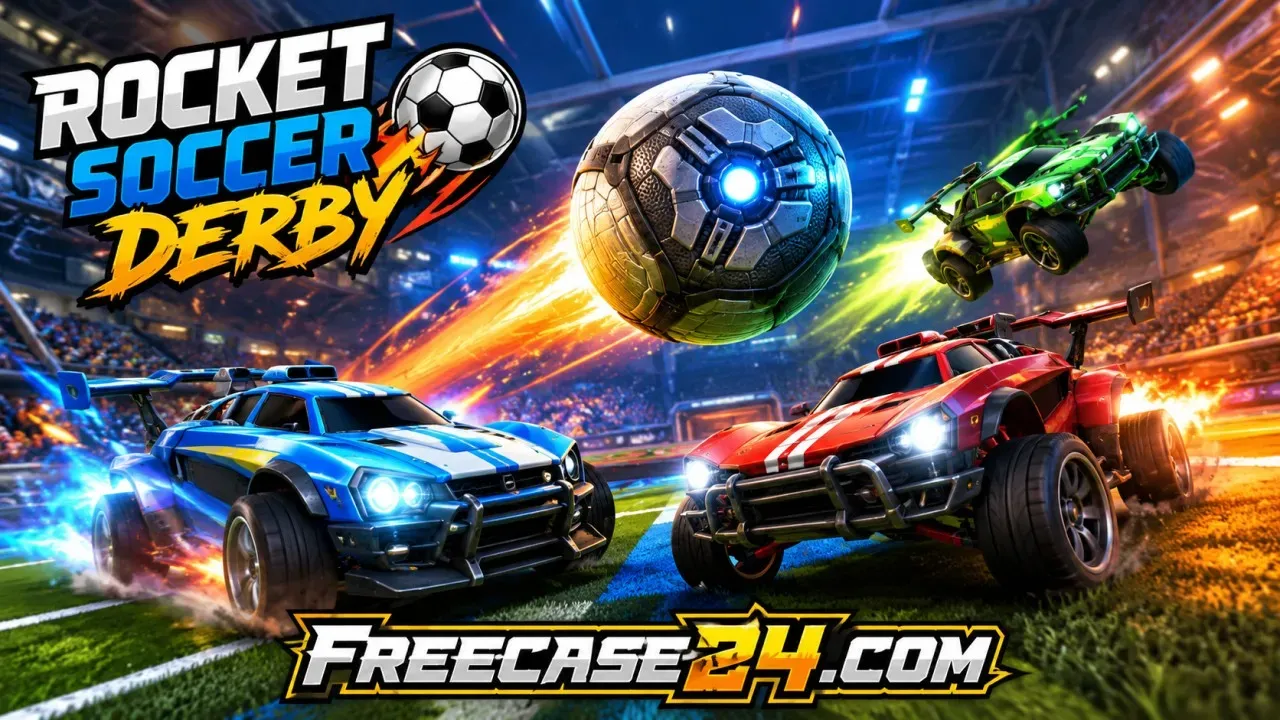
I’m going to make a confession. I am absolute garbage at traditional sports video games. My friends invite me to play FIFA or NBA 2K, and within ten minutes, I’m frantically pressing random buttons while my digital avatar runs directly off the pitch or throws the ball into the third row of the stands. It’s embarrassing. But then you discover something like rocket soccer derby. And suddenly, the rules change entirely. You aren't just running; you are driving a heavily armored, rocket-boosted muscle car into a giant metal soccer ball. It is ridiculous, it is loud, and honestly? It is the most fun I've had with a browser-based game in years.
I remember when this subgenre of vehicle-soccer games first started popping up on flash portals and early web platforms. I spent hours on this addictive HTML5 gaming platform trying to nail my aerial flips and save my team from humiliating defeats. Back then, we didn't expect much from browser games. They were quick distractions for study halls or lunch breaks. But the depth in this specific title caught me completely off guard. It’s not just about hitting the gas and hoping for the best (though, let’s be real, that is about 70% of my current strategy).
The Glorious, Exhausting Madness of Rocket Soccer Derby
Here’s the setup: you’re dropped into a futuristic arena, surrounded by steel walls, with a giant ball dropped right in the center. Your goal is simple. Get the ball into the opponent’s net. But because you’re driving a vehicle that defies several laws of Newtonian physics, nothing is ever simple. You accelerate, you hit the boost, you jump—yes, cars can jump here—and you fly through the air like an metal acrobat with a serious identity crisis.
But what really sets this apart from other arcade games is the sheer unpredictability of the collisions. During my five years of reviewing and writing about indie web games, I’ve noticed that developers usually go one of two ways. They either make the physics so stiff that the game feels like a spreadsheet, or they make them so floaty that you feel like you’re playing underwater. Rocket soccer derby somehow hits this bizarre, sweet spot right in the middle. The cars have weight. When you ram into an opponent at full speed, you don't just nudge them; you send them spinning across the arena in a shower of sparks. It is delightfully violent without actually being violent, if that makes sense.
And let's talk about the visual feedback. It's not AAA graphics—let’s not kid ourselves. But it has this industrial, neon-drenched charm that reminds me of late-90s arcade cabinets. Every time a goal is scored, the ball explodes, sending every car in the vicinity flying backward from the shockwave. It's a small touch, but the sensory reward of that explosion never gets old. I keep coming back to this point because it’s crucial: great games don't need hundred-million-dollar budgets; they just need to make basic actions feel satisfying.
Physics, Panic, and the Learning Curve
A fascinating 2022 analysis on player engagement in physics-based simulations by the Digital Entertainment Association pointed out that the games with the highest retention rates are those where players feel a constant "near-miss" sensation. You know the feeling. You fly through the air, miss the ball by a millimeter, scream at your monitor, and immediately line up for the next shot. That is this game in a nutshell.
While exploring some of the best purpose games on the web to see how gameplay mechanics drive cognitive development, I kept comparing everything back to this chaotic physics sandbox. There's something highly educational—albeit incredibly frustrating—about trying to calculate reflection angles in real-time while a three-ton truck is trying to T-bone you at ninety miles an hour. You start to develop this weird, instinctual understanding of trajectory. You learn to predict where the ball will bounce off the curved corners of the arena. Actually, that's a lie. Half the time, the ball bounces in a way that completely defies logic, and you just have to laugh and scramble back to defend your goal.
Let me try to explain the control scheme. It’s incredibly intuitive but devilishly hard to master. You’ve got your standard WASD controls, a spacebar for handbrakes (crucial for those sudden 180-degree drift turns), and a shift key for the rocket boost. It sounds simple. But wait until you try to combine a jump with a forward pitch while boosting. Suddenly, you're not just driving; you're piloting a clumsy, fuel-guzzling rocket ship. Your hands will cramp. You will miss the ball entirely and fly straight into the opponent's goal net, leaving your own goal completely undefended. Your teammates will probably spam the chat. It’s beautiful.
Strategy Beyond the Chaos (Yes, There Actually Is Some)
You might be wondering: is this just mindless button-mashing? Honestly, I thought so too during my first dozen matches. I figured whoever hit the boost button hardest would win. But after getting absolutely destroyed by a team that actually knew what they were doing, I realized there is a deep layer of tactical depth here. Much like mastering the game of spades rules strategy, you need to understand positioning, reading your opponents, and knowing when to hold back rather than blindly rushing the ball. If everyone on your team is chasing the ball like a bunch of hyperactive golden retrievers, you are going to lose. Badly.
Here are a few hard-earned tips from someone who has spent way too many late nights in these virtual arenas:
- The Anchor Role: Always keep one person back near the midfield. If the ball pinballs off a wall, having a defender ready to clear it is the difference between winning and screaming in frustration.
- Feather the Boost: Do not just hold down the shift key. Use short, controlled bursts to adjust your trajectory mid-air. It saves fuel and keeps you from overshooting.
- Embrace the Derby: Sometimes, the best play isn't hitting the ball. It’s demolishing the opponent's goalie right before your teammate takes a shot. It’s dirty, but highly effective.
The frustrating thing about this game, though, is the occasional server hiccup. Because it's a browser-based multiplayer experience, a sudden spike in ping can turn your precision aerial strike into a sad, lagging drift into the corner. While this has its limitations, it's a minor price to pay for a game you can boot up in five seconds flat without needing to clear 100 gigabytes of space on your hard drive.
Let's Clear the Air: Rocket Soccer Derby FAQs
I know what you're thinking. A game this wild has to have some catches. Here are some of the most common things people ask when they're first dipping their toes into this octane-fueled sport.
Is rocket soccer derby just a cheap knockoff of Rocket League?
While it definitely shares the same DNA, calling it a cheap knockoff does it a disservice. Think of it as a highly accessible, lightweight alternative that you can play on almost any device without installing massive client software. Plus, the emphasis on vehicle demolition and derby elements gives it a distinct, grittier personality.
How do I stop flying past the ball every time I try to hit it?
Stop boosting so much! The biggest rookie mistake is holding down the boost button constantly. Try to align your car with the ball's shadow on the ground first, then use your normal acceleration. Only tap the boost right before impact to add power to your shot.
Can I play this on an old office or school laptop?
Absolutely. Because it runs on HTML5, it is incredibly well-optimized for low-end hardware. You might need to drop the graphic settings slightly in the main menu if you experience frame drops, but generally, if your computer can run a couple of browser tabs, it can run this game.
Do I need to spend real money to unlock the cool cars?
Nope. Every car, skin, and upgrade in the game can be unlocked using the coins you earn simply by playing matches, scoring goals, and completing daily challenges. It actually rewards playtime over wallet size, which is a breath of fresh air these days.
A Final Thought on the Magic of Simple Games
At the end of the day, games like this remind me why I fell in love with gaming in the first place. It’s not about photorealistic ray-tracing or complex narrative arcs that make you question your existence. Sometimes, you just want to sit down after a long day of work, hit a button, turn your brain off, and watch a digital muscle car perform a double backflip to smash a massive soccer ball into a net. It’s simple, honest fun. And honestly? We could all use a little more of that.