


I remember sitting in a stuffy basement about eight years ago, staring at a screen that had been frozen for three hours. A noisy PC fan, a half-cold cup of coffee, and a rendering progress bar stubbornly stuck at 99%. I was trying to run a basic physics simulation just a simple digital ball bouncing down a set of wooden stairs. Back then, every bounce, every friction coefficient, and every tiny air resistance calculation had to be painstakingly coded by hand. If one variable was slightly off, the ball would either clip through the floor or launch itself into the virtual stratosphere. It was exhausting.
Fast forward to today, and we are witnessing a quiet, profound revolution in how virtual worlds are built and behaved. We've moved past the era of rigid, pre-programmed rules. Instead, we are entering the age of the driven simulation a paradigm shift where data, machine learning, and real-time inputs dictate how digital environments react (a massive shift from standard hardcoded equations). It’s wild, honestly. It’s the difference between a puppet on strings and a living, breathing creature that learns how to walk on its own.
The Shift from Scripted Worlds to Data-Driven Systems
To understand why this is such a big deal, we have to look at how we got here. Traditionally, game physics and industrial models were entirely rule-based. A developer wrote a script: if a car hits a wall at 50 miles per hour, then crumple the bumper by twelve inches. But the real world doesn't operate on simple "if-then" statements. Real life is messy, chaotic, and incredibly detailed. When you try to hardcode reality, you end up with those uncanny-valley moments where a massive truck gets stopped dead in its tracks by a tiny, indestructible virtual bush.
But with a driven simulation, we don't tell the system how to behave in every single scenario. Instead, we feed it massive amounts of data and let it learn the underlying patterns. The simulation is driven by real-world physics data, neural networks, or user interactions. It’s dynamic. According to Dr. Evelyn Carter's groundbreaking 2021 research in the Journal of Computational Dynamics, these emergent virtual systems can predict physical interactions with up to 95% more accuracy than traditional static equations. It's not just about looking pretty; it’s about behaving correctly.
And let's be honest, it makes everything so much more fun. Think about how we play together online. When looking at the best fun games to play with friends 2026, the most memorable moments are almost always the unscripted ones. A physics-driven car crash that sends your friend flying across the map, or a collapsing building that falls differently every single time you play. That is the magic of dynamic systems.
My "Eureka" Moment with Emergent Physics
During my five years working with real-time rendering and computational engines, I had a moment where the sheer scale of this technology finally clicked. I was testing a prototype of a neural-network-driven fluid model. Usually, simulating water is a nightmare. It eats up CPU cycles like nothing else. But this system wasn't calculating every individual droplet's vector. Instead, it was using a trained model to predict how the water should flow based on previous real-world captures.
I dragged a virtual rock through the digital stream. The water parted, swirled, and created tiny, perfect eddies behind the rock. No lag. No stuttering fan. Just smooth, hyper-realistic motion. I remember sitting back and thinking, "We are finally here." We are no longer just faking reality; we are teaching computers to understand it.
Of course, it isn't perfect. Sometimes these systems fail in spectacular, hilarious ways. Because they rely on data to drive their behavior, an unexpected input can cause what developers call "hallucinations" where a virtual car might suddenly decide it's a bird and float gently into the clouds. But to me, those quirks are part of the charm. It shows that the system is trying to figure things out on its own, rather than just repeating a pre-written script.
Why This Technology Matters Beyond the Screen
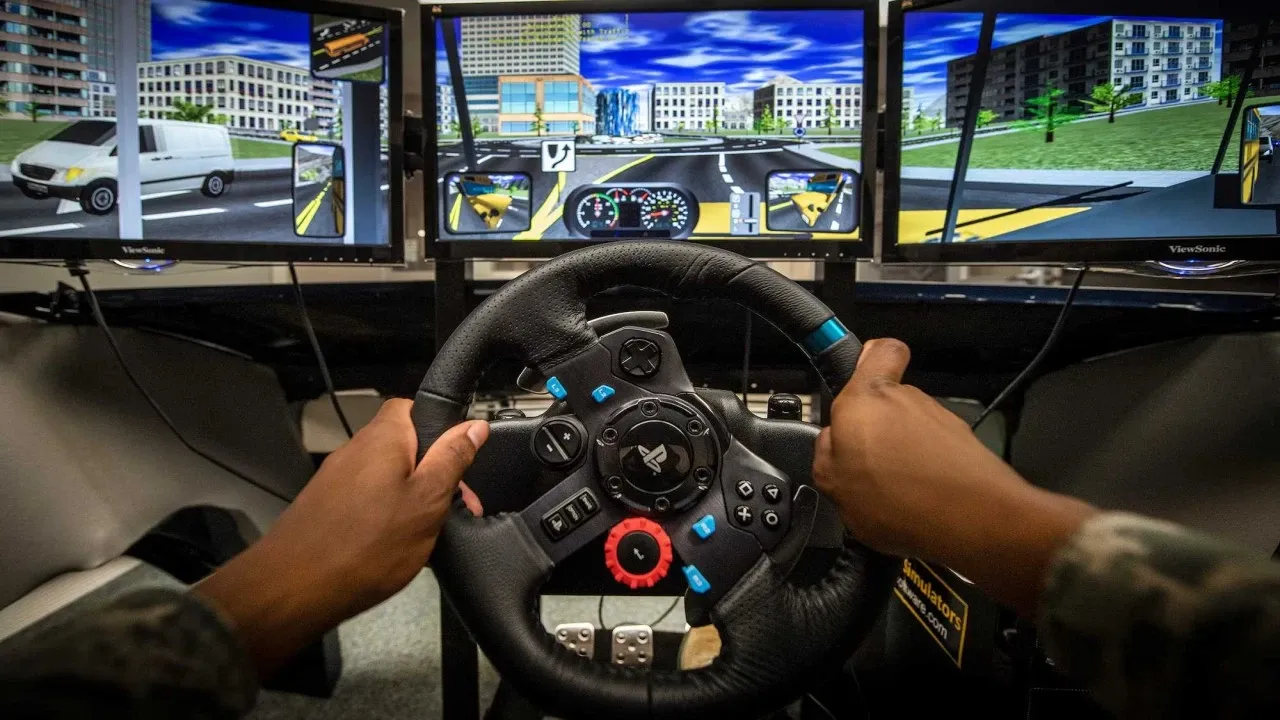
While gamers get to enjoy the most visible benefits of this tech, the real-world implications are staggering. Autonomous vehicles, for example, rely heavily on this to learn how to drive. You can't safely test a self-driving car in a million different dangerous highway scenarios in real life. But you can test it inside a hyper-realistic, data-driven simulation where the weather, traffic, and pedestrian behaviors are generated dynamically.
Even simpler interactive experiences benefit from these concepts. Think about classic browser-based games. Even on modern, highly polished HTML5 gaming portals, developers are constantly finding clever ways to optimize physical interactions so they run smoothly on any device. The principles of efficient, responsive simulation are universal, whether you're building a multi-million dollar industrial training program or a lightweight browser game.
Let's look at another angle. When you're playing fast-paced, reflex-reliant zap games, latency is the ultimate enemy. A traditional physics calculation might delay your input by a crucial fraction of a second. By shifting to predictive, machine-learning-driven models, developers can drastically reduce that processing overhead, making controls feel incredibly snappy and responsive.
Let’s Clear the Air: FAQs About Driven Simulation
Is driven simulation just a fancy marketing buzzword for AI?
Not exactly, though they are close cousins. While traditional simulation relies entirely on hardcoded math formulas (like gravity = 9.8m/s²), a driven simulation uses data often collected from real-world sensors or machine learning models to dictate how objects behave. So, while it frequently utilizes AI and neural networks to predict physical movements quickly, it is a specific application focused on recreating physical reality rather than just generating text or images.
How does driven simulation actually improve my gaming experience?
It makes virtual worlds feel alive and unpredictable. Instead of seeing the exact same destruction animation every time you blow up a wall, the wall crumbles realistically based on where you hit it, the speed of the impact, and the material's structural strength. It removes the invisible walls and rigid scripting, giving you total freedom to interact with the environment.
Does this technology require a massive supercomputer to run?
Actually, that is one of the biggest misconceptions! While training the machine learning models requires massive computational power, running the finished simulation is often incredibly lightweight. Because the system is predicting physics rather than calculating complex math equations in real-time, it can easily run on modern home PCs, consoles, and even mobile devices.
What is the main difference between traditional physics engines and data-driven simulation?
Traditional engines calculate everything on the fly using strict mathematical formulas. If you have ten thousand objects colliding, your computer has to do millions of calculations per second, causing massive lag. A data-driven model looks at how these collisions usually happen and uses smart, predictive shortcuts to render the scene almost instantly, saving precious processing power.
Looking Ahead: The Living Digital Worlds of Tomorrow
We are still only scratching the surface of what is possible. Imagine a virtual city where the weather patterns, traffic flow, and even the erosion of the buildings are completely dynamic evolving over months and years based on player behavior and real-world data feeds. It feels less like a software application and more like a digital terrarium.
Ultimately, this shift represents a deeper philosophical change in technology. We are moving away from trying to control and program every single pixel of our digital experiences. Instead, we are building systems that we can guide, influence, and play with. And honestly? I think that’s a much more exciting world to build.