
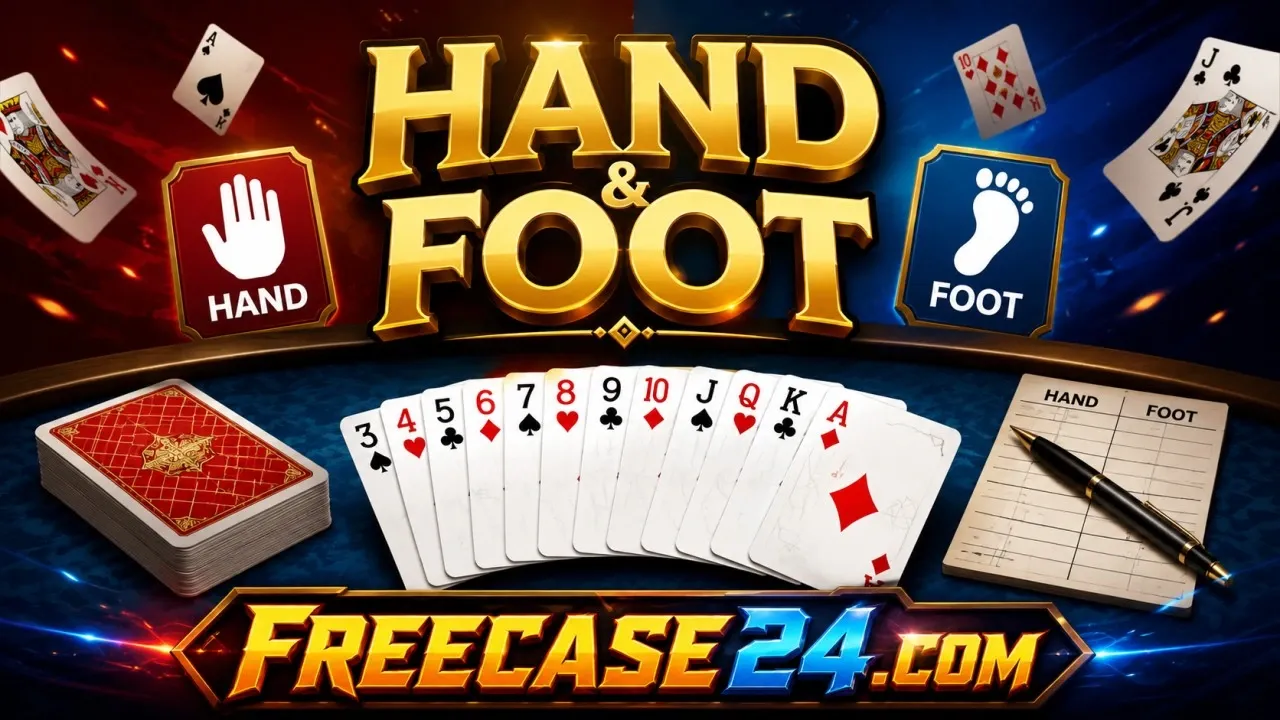
Why the Card Game Hand Foot is My Absolute Favorite Tabletop Obsession (and How to Play It)

Post Object ( [id] => 219 [created_date] => 1785110400 [slug] => card-game-hand-foot [thumbnail_url] => /files/images/card game hand foot.webp [title] => Why the Card Game Hand Foot is My Absolute Favorite Tabletop Obsession (and How to Play It) [content] =>

My grandmother’s dining room table was a battleground. It wasn’t a place for polite, quiet dinners. No, it was a place of coffee rings, half-eaten slices of coffee cake, and an absolutely absurd mountain of playing cards. Five decks, to be precise. If you have never tried to shuffle 260 cards at once, let me tell you right now: it is an actual physical sport. Your hands will cramp. Cards will slide off the table and wedge themselves under the baseboards. But the moment those cards are dealt, all the physical labor is forgotten. You are about to play the card game hand foot, and things are about to get incredibly tense.

If you've never played it, you might think it’s just another generic rummy game. But you'd be wrong. Hand and Foot is like Canasta on performance-enhancing substances. It is chaotic, deeply strategic, occasionally infuriating, and hands-down one of the most bonding tabletop experiences you can have with friends and family. Let me break down why this game deserves a permanent spot on your game night rotation, how you actually play it without losing your mind, and some hard-won strategies I’ve picked up over a decade of playing around crowded, noisy tables.

What on Earth is the Card Game Hand Foot Anyway?

At its core, the card game hand foot is a member of the Canasta family. But while classic Canasta has its own elegant charm, Hand and Foot turns the volume up to eleven. The big twist is right there in the name: instead of playing with just one hand of cards, every player is dealt two separate hands.

Your first stack of cards is your "Hand." You hold this, look at it, and play from it immediately. Your second stack is your "Foot." This pile sits face-down on the table, tantalizing you, completely out of reach until you manage to play every single card in your Hand. It’s a beautifully simple mechanic that completely changes how you think about your turn. You can’t just hoard cards; you have to actively work to empty your current hand so you can finally pick up your Foot and unleash a whole new wave of chaos onto the table.

Usually, you play in partnerships two against two. This is where the real magic happens. You and your partner are working on the same "melds" (sets of clean or dirty cards), but you cannot openly communicate what is in your hands. You have to read their body language, watch their discards, and pray they realize you need that last Clean Ace before they throw away a wild card. It reminds me a bit of the heavy-table politics you get in a tense cmdr game, where you’re constantly eyeing your opponents' boards to see who is about to pop off and destroy your entire strategy.

How the Madness Unfolds: The Basic Rhythm of Play

Let's talk about how a round actually works. We usually use one more deck of cards than the number of players. So, if we have four players, we grab five decks of standard cards (jokers included never forget the jokers!).

The dealing process is a ritual in itself. Someone shuffles this massive monolith of cards, and then everyone takes turns grabbing a chunk. You deal out two piles of 13 cards for each player. One pile goes to your hand, the other is passed to the person on your right to be their "Foot."

Once the game begins, your turn consists of a simple loop:

  • Draw two cards from the draw pile (or pick up the discard pile, but only if you meet the strict rules for doing so).
  • Lay down melds of three or more cards of the same rank (for example, three Kings or four Sevens).
  • Discard one card onto the discard pile.

But the goal isn't just to lay down random cards. You are trying to build "books" of seven cards. A "clean" book consists of seven natural cards of the same rank (like seven Queens) with no wild cards. A "dirty" book has at least four natural cards and up to three wild cards (Deuces and Jokers are wild). Clean books are worth massive points; dirty books are worth less, but they are much easier to complete.

And here is the catch: your team cannot "go out" (end the round) until you have completed at least one clean book and one dirty book, and both you and your partner have successfully played through your "Foot" piles. If you get stuck in your Hand while your partner is screaming through their Foot, you are actively dragging your team down. The pressure is real, and it is glorious.

Strategy Secrets Your Grandma Didn't Want You to Know

When I first started playing, I thought the goal was simply to play cards as fast as possible. Actually, that is a fast track to losing. Hand and Foot is a game of pacing and psychological warfare.

One of the biggest mistakes beginners make is playing their cards too early in the round. If you lay down three Jacks early, you’ve just shown your opponents exactly what you are holding. They will hoard Jacks in their hands, making sure you can never complete that lucrative clean book. Sometimes, it is much smarter to hold onto your sets in your hand, letting them accumulate, and then dropping a massive, completed book onto the table all at once. The look of sheer panic on your opponents' faces when you do this is absolutely priceless.

Another crucial tip: manage your wild cards like they are liquid gold. It is incredibly tempting to use wild cards to quickly dirty up a book just to get into your Foot. But wait! If you hold onto those wild cards, you can use them as flexible shields. They can bail you out of a tight spot when you have nothing else to discard, or they can be used to instantly complete a dirty book right when you are ready to go out. Don't waste them early on cheap melds.

Why We Still Play Real Cards in a Digital World

There is something deeply satisfying about the tactile nature of this game. In an era where we are constantly staring at screens, sitting across a table from three other humans, trash-talking over a pile of cardboard, is therapeutic. It’s an analog escape.

But look, I get it. Sometimes we just don't have four people, three hours to spare, or the physical space to shuffle five decks of cards. In those moments, I find myself sliding toward digital distractions to scratch that gaming itch. When I can't get a group together for cards, I love jumping into something completely different, like exploring nostalgic retro titles on platforms that let you play Nintendo 64 games online free, or just wasting twenty minutes on quick-play casual browser games. But even the best digital games can't quite replicate the chaotic energy of a physical card table.

That is the beauty of the card game hand foot. It demands your attention. It forces you to watch your friends' faces, to laugh at their misfortune when they draw three consecutive garbage cards, and to high-five your partner when they pull off an unexpected play that wins you the round. It’s a social engine disguised as a card game.

Hand and Foot FAQs: Everything You’ve Been Arguing Over at the Table

How many decks of cards do we actually need to play?

The golden rule for the card game hand foot is to use one more deck than the number of players. If you have four players, use five decks. If you have six players, you'll need seven decks. Always keep the jokers in! They act as high-value wild cards that can turn a losing round into a massive victory.

Can I play this game with only two people?

Absolutely! While the game shines brightest with four players in partnerships, playing head-to-head with two people is incredibly intense. It becomes a much more tactical, cutthroat duel because you don't have a partner to help you complete your books. You have to do all the heavy lifting yourself.

What happens if I accidentally look at my Foot too early?

We’ve all done it the excitement gets the better of you, and you sneak a peek. In strict tournament rules, this is a penalty, often resulting in a point deduction. In friendly kitchen-table rules? Usually, you just get roasted by your family for the rest of the night. Keep those Foot cards face down until your Hand is completely empty!

What is the difference between Hand and Foot and regular Canasta?

While they share the same basic concept of making melds and books, Canasta uses fewer cards and only one hand. Hand and Foot introduces the second pile of cards (the Foot), which adds a whole new layer of pacing. You also need to complete both a clean and a dirty book to win in Hand and Foot, making the endgame much more challenging.

How do you "go out" without making your partner angry?

Communication is key, even if it has to be subtle. Before you discard your final card and end the round, you must ask your partner, "May I go out?" If your partner is still stuck with a hand full of high-value cards that will count as negative points, they should say "No!" Respect their answer, or prepare for some very quiet car rides home.

The Final Card

Ultimately, games like Hand and Foot persist because they aren't just about winning; they are about the stories we build while playing them. I still remember the night my uncle managed to go out when my aunt was holding 150 points worth of red threes in her Foot. The mock outrage, the laughter, the dramatic throwing of cards that is what stays with you. So grab some friends, clear off your kitchen table, buy a bulk pack of playing cards, and get ready for a lifetime of beautiful, chaotic rivalry.

[fields] => [extra_fields] => {"post-meta-title":"Card Game Hand Foot Rules, Tips & Winning Strategy Guide","post-meta-description":"Learn Card Game Hand Foot with simple rules, scoring, winning strategies, and gameplay tips. Perfect for beginners, families, and card game fans.","post-meta-keyword":"card game hand foot","source_text":"","source_link":"","faq":""} )
Why the Card Game Hand Foot is My Absolute Favorite Tabletop Obsession (and How to Play It)

My grandmother’s dining room table was a battleground. It wasn’t a place for polite, quiet dinners. No, it was a place of coffee rings, half-eaten slices of coffee cake, and an absolutely absurd mountain of playing cards. Five decks, to be precise. If you have never tried to shuffle 260 cards at once, let me tell you right now: it is an actual physical sport. Your hands will cramp. Cards will slide off the table and wedge themselves under the baseboards. But the moment those cards are dealt, all the physical labor is forgotten. You are about to play the card game hand foot, and things are about to get incredibly tense.

If you've never played it, you might think it’s just another generic rummy game. But you'd be wrong. Hand and Foot is like Canasta on performance-enhancing substances. It is chaotic, deeply strategic, occasionally infuriating, and hands-down one of the most bonding tabletop experiences you can have with friends and family. Let me break down why this game deserves a permanent spot on your game night rotation, how you actually play it without losing your mind, and some hard-won strategies I’ve picked up over a decade of playing around crowded, noisy tables.

What on Earth is the Card Game Hand Foot Anyway?

At its core, the card game hand foot is a member of the Canasta family. But while classic Canasta has its own elegant charm, Hand and Foot turns the volume up to eleven. The big twist is right there in the name: instead of playing with just one hand of cards, every player is dealt two separate hands.

Your first stack of cards is your "Hand." You hold this, look at it, and play from it immediately. Your second stack is your "Foot." This pile sits face-down on the table, tantalizing you, completely out of reach until you manage to play every single card in your Hand. It’s a beautifully simple mechanic that completely changes how you think about your turn. You can’t just hoard cards; you have to actively work to empty your current hand so you can finally pick up your Foot and unleash a whole new wave of chaos onto the table.

Usually, you play in partnerships two against two. This is where the real magic happens. You and your partner are working on the same "melds" (sets of clean or dirty cards), but you cannot openly communicate what is in your hands. You have to read their body language, watch their discards, and pray they realize you need that last Clean Ace before they throw away a wild card. It reminds me a bit of the heavy-table politics you get in a tense cmdr game, where you’re constantly eyeing your opponents' boards to see who is about to pop off and destroy your entire strategy.

How the Madness Unfolds: The Basic Rhythm of Play

Let's talk about how a round actually works. We usually use one more deck of cards than the number of players. So, if we have four players, we grab five decks of standard cards (jokers included never forget the jokers!).

The dealing process is a ritual in itself. Someone shuffles this massive monolith of cards, and then everyone takes turns grabbing a chunk. You deal out two piles of 13 cards for each player. One pile goes to your hand, the other is passed to the person on your right to be their "Foot."

Once the game begins, your turn consists of a simple loop:

  • Draw two cards from the draw pile (or pick up the discard pile, but only if you meet the strict rules for doing so).
  • Lay down melds of three or more cards of the same rank (for example, three Kings or four Sevens).
  • Discard one card onto the discard pile.

But the goal isn't just to lay down random cards. You are trying to build "books" of seven cards. A "clean" book consists of seven natural cards of the same rank (like seven Queens) with no wild cards. A "dirty" book has at least four natural cards and up to three wild cards (Deuces and Jokers are wild). Clean books are worth massive points; dirty books are worth less, but they are much easier to complete.

And here is the catch: your team cannot "go out" (end the round) until you have completed at least one clean book and one dirty book, and both you and your partner have successfully played through your "Foot" piles. If you get stuck in your Hand while your partner is screaming through their Foot, you are actively dragging your team down. The pressure is real, and it is glorious.

Strategy Secrets Your Grandma Didn't Want You to Know

When I first started playing, I thought the goal was simply to play cards as fast as possible. Actually, that is a fast track to losing. Hand and Foot is a game of pacing and psychological warfare.

One of the biggest mistakes beginners make is playing their cards too early in the round. If you lay down three Jacks early, you’ve just shown your opponents exactly what you are holding. They will hoard Jacks in their hands, making sure you can never complete that lucrative clean book. Sometimes, it is much smarter to hold onto your sets in your hand, letting them accumulate, and then dropping a massive, completed book onto the table all at once. The look of sheer panic on your opponents' faces when you do this is absolutely priceless.

Another crucial tip: manage your wild cards like they are liquid gold. It is incredibly tempting to use wild cards to quickly dirty up a book just to get into your Foot. But wait! If you hold onto those wild cards, you can use them as flexible shields. They can bail you out of a tight spot when you have nothing else to discard, or they can be used to instantly complete a dirty book right when you are ready to go out. Don't waste them early on cheap melds.

Why We Still Play Real Cards in a Digital World

There is something deeply satisfying about the tactile nature of this game. In an era where we are constantly staring at screens, sitting across a table from three other humans, trash-talking over a pile of cardboard, is therapeutic. It’s an analog escape.

But look, I get it. Sometimes we just don't have four people, three hours to spare, or the physical space to shuffle five decks of cards. In those moments, I find myself sliding toward digital distractions to scratch that gaming itch. When I can't get a group together for cards, I love jumping into something completely different, like exploring nostalgic retro titles on platforms that let you play Nintendo 64 games online free, or just wasting twenty minutes on quick-play casual browser games. But even the best digital games can't quite replicate the chaotic energy of a physical card table.

That is the beauty of the card game hand foot. It demands your attention. It forces you to watch your friends' faces, to laugh at their misfortune when they draw three consecutive garbage cards, and to high-five your partner when they pull off an unexpected play that wins you the round. It’s a social engine disguised as a card game.

Hand and Foot FAQs: Everything You’ve Been Arguing Over at the Table

How many decks of cards do we actually need to play?

The golden rule for the card game hand foot is to use one more deck than the number of players. If you have four players, use five decks. If you have six players, you'll need seven decks. Always keep the jokers in! They act as high-value wild cards that can turn a losing round into a massive victory.

Can I play this game with only two people?

Absolutely! While the game shines brightest with four players in partnerships, playing head-to-head with two people is incredibly intense. It becomes a much more tactical, cutthroat duel because you don't have a partner to help you complete your books. You have to do all the heavy lifting yourself.

What happens if I accidentally look at my Foot too early?

We’ve all done it the excitement gets the better of you, and you sneak a peek. In strict tournament rules, this is a penalty, often resulting in a point deduction. In friendly kitchen-table rules? Usually, you just get roasted by your family for the rest of the night. Keep those Foot cards face down until your Hand is completely empty!

What is the difference between Hand and Foot and regular Canasta?

While they share the same basic concept of making melds and books, Canasta uses fewer cards and only one hand. Hand and Foot introduces the second pile of cards (the Foot), which adds a whole new layer of pacing. You also need to complete both a clean and a dirty book to win in Hand and Foot, making the endgame much more challenging.

How do you "go out" without making your partner angry?

Communication is key, even if it has to be subtle. Before you discard your final card and end the round, you must ask your partner, "May I go out?" If your partner is still stuck with a hand full of high-value cards that will count as negative points, they should say "No!" Respect their answer, or prepare for some very quiet car rides home.

The Final Card

Ultimately, games like Hand and Foot persist because they aren't just about winning; they are about the stories we build while playing them. I still remember the night my uncle managed to go out when my aunt was holding 150 points worth of red threes in her Foot. The mock outrage, the laughter, the dramatic throwing of cards that is what stays with you. So grab some friends, clear off your kitchen table, buy a bulk pack of playing cards, and get ready for a lifetime of beautiful, chaotic rivalry.