

Few social games have the staying power of the bunco game. It has been played at kitchen tables, church halls, and neighbourhood gatherings for over a century and in an era where most social activities have migrated to screens, bunco remains one of the rare exceptions where getting people physically together in the same room is the entire point. If you have heard the name but never played, or you played once years ago and cannot quite remember how the scoring worked, this guide covers everything clearly and completely.
What Is the Bunco Game ?
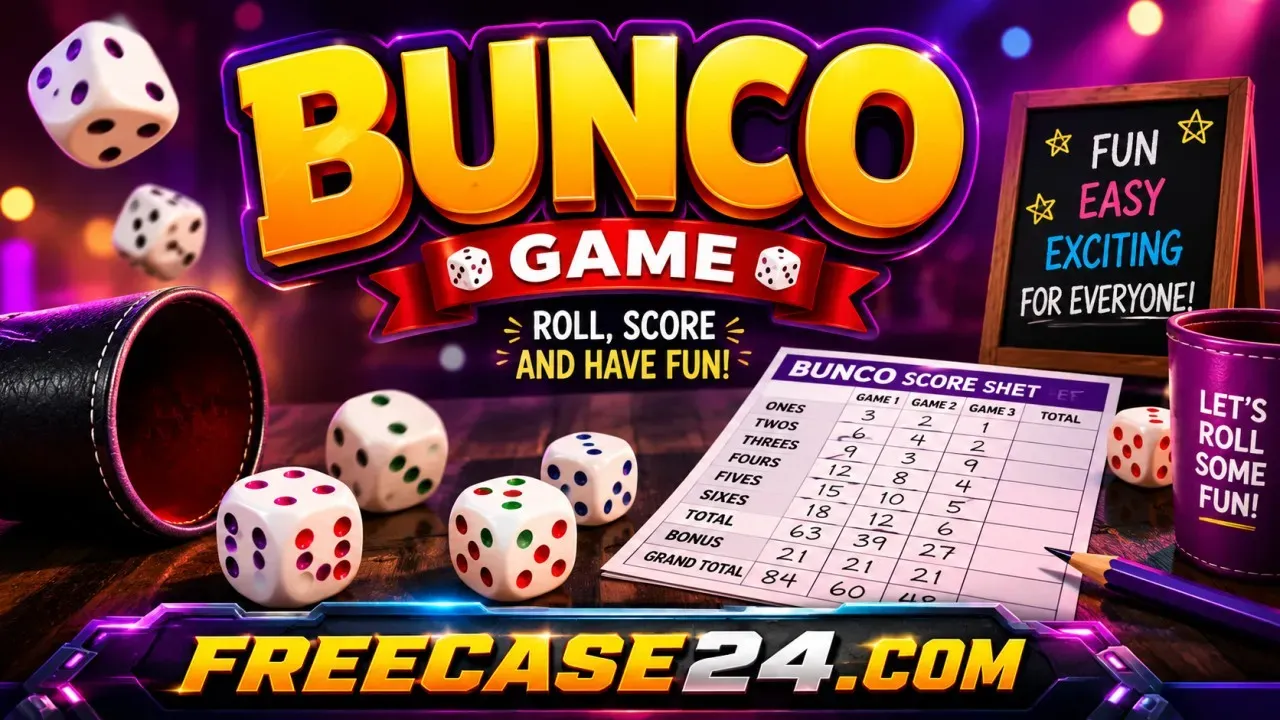
The bunco game is a dice game for twelve players divided into three tables of four. Players roll three dice in rounds, trying to match the target number for that round and the game moves fast. Very fast. There is almost no skill involved in the traditional sense no strategy, no complex decisions, no need to memorise rules beyond the basics. What bunco delivers instead is noise, movement, table rotation, and the kind of competitive energy that makes time disappear faster than anyone planned.
This simplicity is a feature rather than a limitation. Bunco is designed to be a social vehicle first and a game second an excuse for twelve people to spend an evening together, rotate tables, talk to everyone in the room, and compete just enough to make it interesting.
What You Need to Play Bunco ?
The equipment list is minimal:
- 36 dice three per player, twelve players, three tables.
- A scoresheet for each player tracking wins, losses, and buncos.
- A bell or signal used to start and stop each round.
- A head table typically the table where the bell is kept and rounds are officially started.
- Small prizes optional but traditional, awarded for most wins, most losses, and most buncos.
Some groups also use a fuzzy die or a small token as a "bunco trophy" that passes between players who score a bunco. This is entirely optional but adds a physical element that most groups enjoy.
How the Bunco Game Is Structured ?
Understanding the overall structure makes the round-by-round rules immediately clear.
The basic structure:
- 6 rounds in a full game (one for each number on a die 1 through 6)
- Each round consists of up to 6 sets
- Players sit at three tables the head table, table two, and table three
- At each table, players split into two teams of two facing each other
- Teams score points by rolling dice and matching the target number for that round
At the end of each set, the winning team at each table scores a point. The losing team does not. Play continues until one team at the head table reaches 21 points at which point the bell rings and the round ends for everyone simultaneously regardless of score at the other tables.
After each round, players rotate. Winners move to a higher table, losers stay or move down, and partners split up. This rotation is what makes bunco a social game rather than a static one by the end of the night, most players will have spent time at every table and partnered with several different people.
Bunco Game Rules Round by Round
Round 1 Rolling for Ones
The target number for round 1 is 1. When the bell rings, all three tables begin rolling simultaneously.
How scoring works within a set:
- Each die showing the target number scores 1 point for your team
- If all three dice show the target number on a single roll, that is a bunco worth 21 points and automatically wins the set for your team
- If all three dice match any number that is not the target number, that is a mini-bunco or a wiggly worth 5 points depending on your group's house rules
- Players keep rolling as quickly as possible until the bell signals the end of the set
The speed element is part of what makes the bunco game chaotic and fun. There is no turn-taking both players on a team can be rolling simultaneously, and everyone at the table is rolling at the same time.
Rounds 2 Through 6
The target number changes each round round 2 targets 2s, round 3 targets 3s, and so on through 6. The rules within each round remain identical. Only the number you are rolling for changes.
Bunco Scoring The Complete System
This is the part that confuses most new players, so here is the full breakdown in a format that makes it easy to track:
Within a set:
- 1 point per die matching the target number
- 5 points for rolling three matching dice that are not the target number (house rule varies by group)
- 21 points for rolling bunco three dice matching the target number on the same roll
After each set:
- The winning team at each table marks a W on their scoresheet
- The losing team marks an L
- Any player who rolled a bunco during the set marks it separately on their scoresheet
After all 6 rounds:
- Count total Ws the player with the most wins is the overall winner
- Count total buncos the player with the most buncos wins a separate prize
- Most losses often wins a consolation prize which adds a layer of strategy-free fun to every result
Most groups keep individual score even though the game is team based, because players rotate partners across the evening and individual tracking creates a personal stake in every roll.
Common House Rules That Change the Game
The bunco game has been adapted so many times across different communities that what one group considers standard rules another group has never heard of. Here are the most common variations:
- Wiggly bunco three matching dice that are not the target number score 5 points instead of the standard 1 point per die. Some groups call this a mini-bunco and treat it as a prize category
- No 21-point ceiling some groups play without stopping the set when one team reaches 21, instead continuing until a bunco is rolled
- Travel bunco a variation where the physical bunco prize (the fuzzy die or token) travels between players each time a bunco is scored rather than being kept until the end
- Speed rounds a time-limited version where sets end after one minute regardless of score
Establishing which house rules your group uses before starting prevents the arguments that traditionally happen during the third round when someone realises they have been scoring differently from everyone else.
Running a Successful Bunco Night
The game itself takes approximately two hours for a full six-round session. Most of that time is playing, but the setup, rotation explanation for new players, and prize distribution add another thirty to forty minutes in practice.
Practical tips for hosting:
- Label tables clearly head table, table two, table three and post the rotation directions before the game starts
- Prepare printed scoresheets rather than asking people to draw their ownit speeds up setup significantly
- Designate one person as the official bell-ringer at the head table to avoid disputes about when sets end
- Set prizes in advance so everyone knows what they are playing for most wins, most buncos, and most losses are the traditional three categories
- Keep a cheat sheet on each table showing that round's target number and the scoring rules until everyone is confident
The Social Side of Bunco That Makes It Work
The reason the bunco game has survived for generations without changing significantly is that the rules are almost secondary to the social experience they create. The rotation system means guests meet every person in the room. The speed of rolling means there is no dead time where players sit waiting for something to happen. The randomness means that skill level is completely irrelevant a first-time player has the same chance of winning as someone who has played every month for ten years.
For group organisers, bunco solves a specific problem that most social games cannot it scales to exactly twelve people, keeps everyone engaged simultaneously, and produces a clear winner without anyone feeling like the result was unfair. That combination is genuinely rare in social game design.
Free Games to Play Between Bunco Sessions
Between bunco nights, the gaming instinct does not disappear it just needs a different outlet. Freecase24 covers every game category imaginable, completely free and instantly accessible in any browser without a download or account.
The Action Games section on Freecase24 suits players who enjoy the competitive intensity of a bunco round fast decisions, immediate feedback, and clear outcomes that reset quickly for another attempt.
For players drawn to exploration and narrative between social gaming sessions, Adventure Games on Freecase24 provide a completely different pace discovery-focused gameplay that rewards curiosity rather than speed.
The Arcade Games category delivers the same kind of quick, casual satisfaction that makes bunco so enjoyable simple mechanics, fast sessions, and the kind of immediate engagement that does not require reading a rulebook before starting.
Shooting Games on Freecase24 appeal to the competitive edge that bunco nights tend to bring out precision-based challenges where every attempt produces a measurable result worth improving on.
And when the energy after a bunco night is still running high, Racing Games on Freecase24 channel that competitive excitement into speed-based browser racing that suits quick sessions and immediate replay.
All five categories are completely free on Freecase24 no download, no sign-up, open and play immediately across desktop, tablet, and mobile.
Final Verdict
The bunco game remains popular not because it is the most strategically complex social game available, but because it brings people together in a simple, enjoyable, and engaging way. The rules take only a few minutes to learn, the scoring becomes familiar after the first round, and the fun continues throughout the entire gathering. Its easy-to-follow format makes it perfect for family gatherings, parties, clubs, and community events.
Whether you're discovering Bunco for the first time or planning your next game night, Freecase24 is a great place to explore more free games, gaming guides, and entertaining content. It's easy to see why Bunco has remained a favorite for generations and why every game night ends with someone asking, "When are we playing again?