A Game Is Said to Be Fair If: Fair Play Made Simple

Post Object ( [id] => 204 [created_date] => 1784332800 [slug] => a-game-is-said-to-be-fair-if [thumbnail_url] => /files/images/a game is said to be fair if.webp [title] => A Game Is Said to Be Fair If: Fair Play Made Simple [content] =>

Imagine flipping a coin with a friend to decide who gets the last slice of pizza. You'd probably assume the odds are 50-50 but why do you assume that? What actually makes that assumption true? This everyday moment is a perfect entry point into a concept that shows up in math class, casino floors, sports arenas, and online gaming platforms alike. The phrase a game is said to be fair if describes a specific set of conditions, and once you understand them, you'll start noticing fairness (or the lack of it) everywhere.

This article breaks the idea down step by step, using real examples instead of dry theory. We'll also look at how fairness plays out in modern gaming, including categories like puzzle games, racing games, and shooting games available on Freecase24, where balanced gameplay is treated as a design priority rather than an afterthought.

Starting With a Question, Not a Definition

Most explanations jump straight into formulas. Let's do the opposite. Before defining fairness mathematically, ask yourself these three questions about any game:​

  • Does every player start from the same position?
  • Does luck (if involved) treat everyone equally?
  • Could the outcome be predicted or controlled by anyone in advance?

If you answered "yes, yes, no" congratulations, you've just informally worked out whether a game is fair. The formal definition simply puts numbers behind these same intuitions.

Breaking Down the Formal Meaning

In probability and statistics, a game is said to be fair if the long-run average outcome (called expected value) works out to zero gain or loss for every participant. In plainer terms: if you played the game thousands of times, no one should walk away consistently ahead or behind purely because of how the game is structured.

Here's how that plays out with common examples:

Scenario
Fair?
Why
Tossing a balanced coin
Yes
50% chance for each side
Rolling a standard six-sided die
Yes
Equal 1-in-6 chance per number
Drawing from a stacked deck
No
Certain cards appear more often than they should
A rigged slot machine
No
Odds are secretly weighted toward the house

Notice the pattern: fairness always comes back to equal probability and the absence of hidden manipulation. Nothing more mysterious than that.

A Simple Formula Worth Knowing

For those who want the math spelled out, a game involving prizes or points is fair when:

Expected Value = (Probability of Win × Reward) − (Probability of Loss × Cost)

If this value equals zero, the game is balanced. If it's positive, one side has an advantage; if negative, they're at a disadvantage. This formula is often used in classrooms to test whether a proposed betting game, raffle, or point system is genuinely fair or secretly tilted.

Where Fairness Actually Gets Tested: Real Gameplay

Textbook examples like coins and dice are useful for learning the theory, but fairness gets far more interesting and complicated once you apply it to actual video games. Different genres test fairness in completely different ways.

Puzzle Games

Fairness in Puzzle games isn't about randomness at all it's about logical consistency. A well-designed puzzle gives every player the exact same tools and clues needed to solve it. There's no luck involved; two players with equal reasoning skills should be able to reach the same solution through the same steps.

Racing Games

Racing games rely on identical starting conditions to stay fair. Same track, same base vehicle stats, same physics engine for everyone. The moment one player's car handles differently under the same inputs, or one connection lags behind another, fairness quietly disappears even if no one intended it.

Shooting Games

In Shooting games fairness often comes down to milliseconds. Hit registration, server response time, and consistent damage calculations all need to work identically for every player. A fair shooting game rewards accuracy and reaction speed — not whoever happens to have the better internet connection that day.

Adventure Games

Adventure games test fairness through information, not speed. A fair adventure title gives players enough environmental clues or story context to figure out what to do next. Sudden, unexplained deaths or impossible-to-guess solutions break the sense of fairness, even if the game is otherwise well made.

Arcade Games

Arcade games lean on fair difficulty scaling. As a player improves, the challenge should rise at a steady, predictable pace. A fair arcade game feels tough but beatable never like the difficulty jumped for no reason just to force a loss.

Why This Matters More Than People Realize ?

It's tempting to treat fairness as a "nice to have" instead of something essential, but the consequences of unfair systems are very real:​

  • Trust erosion once players suspect manipulation, they rarely give a platform a second chance
  • Legal exposure many regions have strict regulations around fairness in games involving prizes or money
  • Poor long-term engagement unfair systems might boost short-term excitement but drive away consistent players
  • Reputation damage online communities are quick to expose and discuss suspected unfair mechanics

This is precisely why Freecase24 treats fairness as a core design standard, not a marketing buzzword. Every game category on the platform from puzzle games to arcade games is built around consistent, transparent mechanics.

A Practical Checklist for Spotting Unfair Games

Next time you're unsure whether a game (digital or physical) is playing it straight, run through this quick checklist:​

  1. Repeat the same action multiple times. Do results match what probability would predict?
  2. Compare starting conditions. Is everyone beginning from an equal position?
  3. Look for transparency in rules. Vague or hidden scoring systems are a red flag.
  4. Watch for consistency under pressure. Do outcomes change unexpectedly during high-stakes moments?
  5. Check community discussions. Other players often spot patterns of unfairness before it's officially confirmed.

None of these checks require advanced math just careful observation and a bit of skepticism.

Bringing It All Together

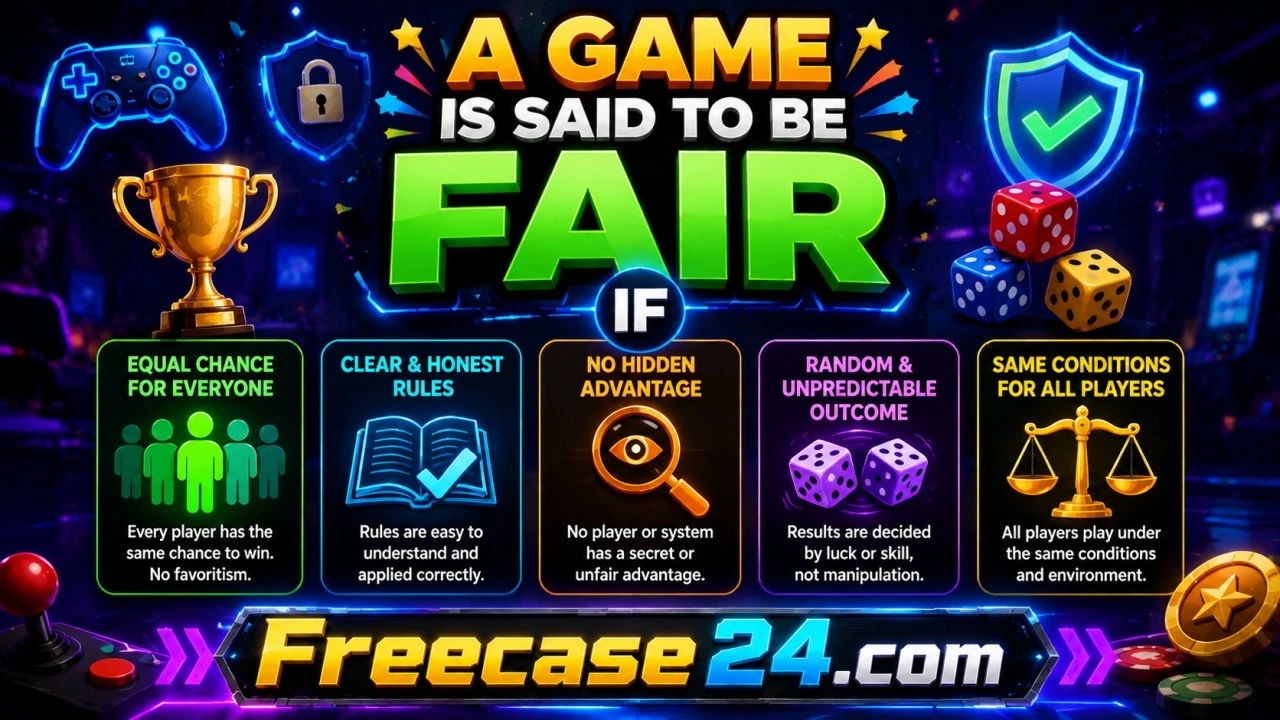
So, to circle back to the original question: a game is said to be fair if every player faces equal probability, no one holds a hidden advantage, and outcomes are driven by genuine skill or true randomness rather than manipulation. That's it  no complicated theory required, just consistency and transparency applied honestly.

Whether you're solving a probability problem in class or jumping into a session of racing games or shooting games online, this same principle applies. At Freecase24 that principle shapes how every game category puzzle, racing, shooting, adventure, and arcade is designed, tested, and maintained, so players can focus on enjoying the game instead of second-guessing the system behind it.

[fields] => [extra_fields] => {"post-meta-title":"A Game Is Said to Be Fair If: Fair Play Made Simple","post-meta-description":"A Game Is Said to Be Fair If every player has an equal chance to succeed. Learn the meaning, key principles, and real-world examples clearly.","post-meta-keyword":"a game is said to be fair if","source_text":"","source_link":"","faq":""} )
A Game Is Said to Be Fair If: Fair Play Made Simple

Imagine flipping a coin with a friend to decide who gets the last slice of pizza. You'd probably assume the odds are 50-50 but why do you assume that? What actually makes that assumption true? This everyday moment is a perfect entry point into a concept that shows up in math class, casino floors, sports arenas, and online gaming platforms alike. The phrase a game is said to be fair if describes a specific set of conditions, and once you understand them, you'll start noticing fairness (or the lack of it) everywhere.

This article breaks the idea down step by step, using real examples instead of dry theory. We'll also look at how fairness plays out in modern gaming, including categories like puzzle games, racing games, and shooting games available on Freecase24, where balanced gameplay is treated as a design priority rather than an afterthought.

Starting With a Question, Not a Definition

Most explanations jump straight into formulas. Let's do the opposite. Before defining fairness mathematically, ask yourself these three questions about any game:​

  • Does every player start from the same position?
  • Does luck (if involved) treat everyone equally?
  • Could the outcome be predicted or controlled by anyone in advance?

If you answered "yes, yes, no" congratulations, you've just informally worked out whether a game is fair. The formal definition simply puts numbers behind these same intuitions.

Breaking Down the Formal Meaning

In probability and statistics, a game is said to be fair if the long-run average outcome (called expected value) works out to zero gain or loss for every participant. In plainer terms: if you played the game thousands of times, no one should walk away consistently ahead or behind purely because of how the game is structured.

Here's how that plays out with common examples:

Scenario
Fair?
Why
Tossing a balanced coin
Yes
50% chance for each side
Rolling a standard six-sided die
Yes
Equal 1-in-6 chance per number
Drawing from a stacked deck
No
Certain cards appear more often than they should
A rigged slot machine
No
Odds are secretly weighted toward the house

Notice the pattern: fairness always comes back to equal probability and the absence of hidden manipulation. Nothing more mysterious than that.

A Simple Formula Worth Knowing

For those who want the math spelled out, a game involving prizes or points is fair when:

Expected Value = (Probability of Win × Reward) − (Probability of Loss × Cost)

If this value equals zero, the game is balanced. If it's positive, one side has an advantage; if negative, they're at a disadvantage. This formula is often used in classrooms to test whether a proposed betting game, raffle, or point system is genuinely fair or secretly tilted.

Where Fairness Actually Gets Tested: Real Gameplay

Textbook examples like coins and dice are useful for learning the theory, but fairness gets far more interesting and complicated once you apply it to actual video games. Different genres test fairness in completely different ways.

Puzzle Games

Fairness in Puzzle games isn't about randomness at all it's about logical consistency. A well-designed puzzle gives every player the exact same tools and clues needed to solve it. There's no luck involved; two players with equal reasoning skills should be able to reach the same solution through the same steps.

Racing Games

Racing games rely on identical starting conditions to stay fair. Same track, same base vehicle stats, same physics engine for everyone. The moment one player's car handles differently under the same inputs, or one connection lags behind another, fairness quietly disappears even if no one intended it.

Shooting Games

In Shooting games fairness often comes down to milliseconds. Hit registration, server response time, and consistent damage calculations all need to work identically for every player. A fair shooting game rewards accuracy and reaction speed — not whoever happens to have the better internet connection that day.

Adventure Games

Adventure games test fairness through information, not speed. A fair adventure title gives players enough environmental clues or story context to figure out what to do next. Sudden, unexplained deaths or impossible-to-guess solutions break the sense of fairness, even if the game is otherwise well made.

Arcade Games

Arcade games lean on fair difficulty scaling. As a player improves, the challenge should rise at a steady, predictable pace. A fair arcade game feels tough but beatable never like the difficulty jumped for no reason just to force a loss.

Why This Matters More Than People Realize ?

It's tempting to treat fairness as a "nice to have" instead of something essential, but the consequences of unfair systems are very real:​

  • Trust erosion once players suspect manipulation, they rarely give a platform a second chance
  • Legal exposure many regions have strict regulations around fairness in games involving prizes or money
  • Poor long-term engagement unfair systems might boost short-term excitement but drive away consistent players
  • Reputation damage online communities are quick to expose and discuss suspected unfair mechanics

This is precisely why Freecase24 treats fairness as a core design standard, not a marketing buzzword. Every game category on the platform from puzzle games to arcade games is built around consistent, transparent mechanics.

A Practical Checklist for Spotting Unfair Games

Next time you're unsure whether a game (digital or physical) is playing it straight, run through this quick checklist:​

  1. Repeat the same action multiple times. Do results match what probability would predict?
  2. Compare starting conditions. Is everyone beginning from an equal position?
  3. Look for transparency in rules. Vague or hidden scoring systems are a red flag.
  4. Watch for consistency under pressure. Do outcomes change unexpectedly during high-stakes moments?
  5. Check community discussions. Other players often spot patterns of unfairness before it's officially confirmed.

None of these checks require advanced math just careful observation and a bit of skepticism.

Bringing It All Together

So, to circle back to the original question: a game is said to be fair if every player faces equal probability, no one holds a hidden advantage, and outcomes are driven by genuine skill or true randomness rather than manipulation. That's it  no complicated theory required, just consistency and transparency applied honestly.

Whether you're solving a probability problem in class or jumping into a session of racing games or shooting games online, this same principle applies. At Freecase24 that principle shapes how every game category puzzle, racing, shooting, adventure, and arcade is designed, tested, and maintained, so players can focus on enjoying the game instead of second-guessing the system behind it.